
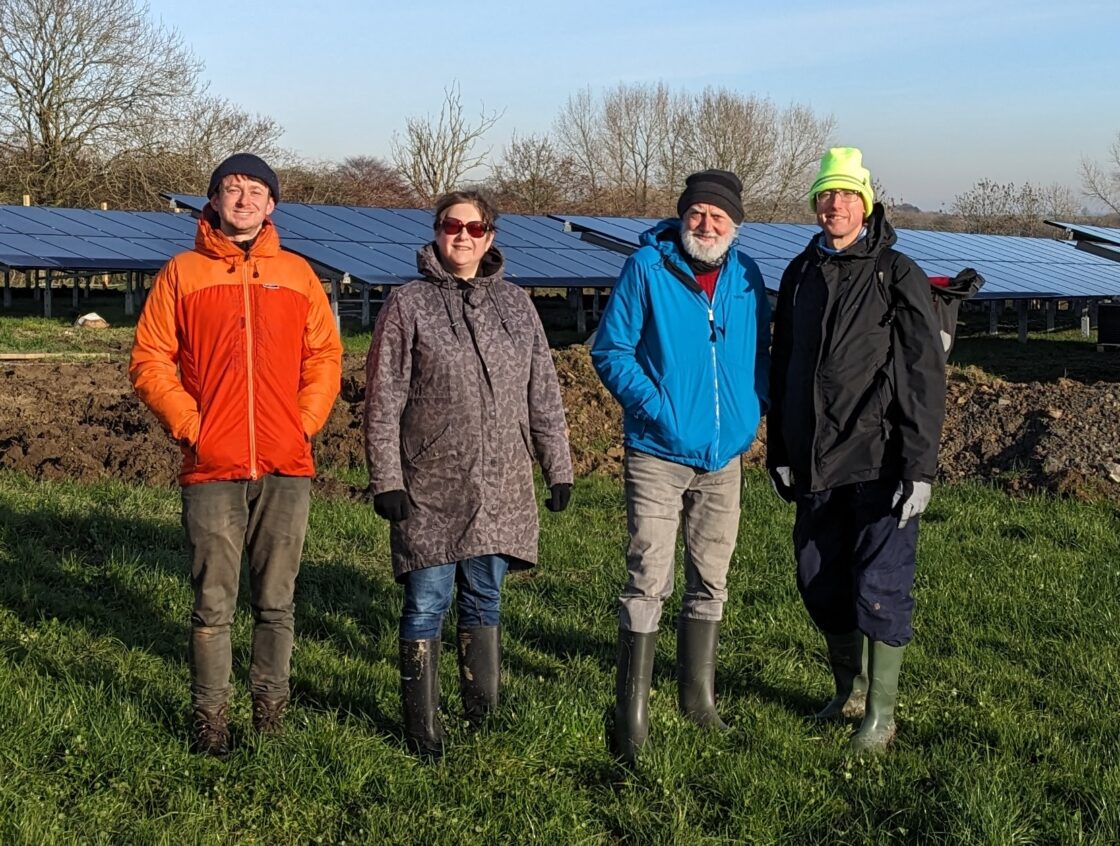
Our Development Manager, Dave Green, is retiring this month. We can’t thank Dave enough for his incredible work over the years, and we wish him a great retirement – though we remain committed to some exciting shared projects together.
Here Dave reflects on his time at Sharenergy and what lessons it can teach us about the future of community energy generation projects.
After six and a half years leading Sharenergy’s Development Team it’s time for me to retire, though I will still be working on the Bishop’s Castle wind project as a volunteer and will still be a director of Shropshire and Telford Community Energy and Community Energy Together, so I’m not leaving the sector.
It’s been an amazing few years with many interesting and challenging projects to work on and we can point to some successes. The team have been very supportive of the Big Solar Co-op, particularly in the early stages and more recently in helping to get the Whiteborough solar farm built. We provided key support to Shropshire & Telford Community Energy in buying the 10MW Twemlows solar farm and helped with share offers for Corwen’s second hydro and South Staffordshire Community Energy’s recent rooftop solar offer. We also did some very detailed work on Community Heat through the Community Heat Development project.
However, of the many projects we’ve worked on very few have led to anything new getting built, with most of them falling by the wayside – though one or two might still get built, including the Bishop’s Castle 1MW wind turbine that received planning permission last year.
Many of these projects failed because of issues with the landowner, including Southport wind and Buttermere hydro. Some just weren’t viable including Oswaldtwistle 2MW solar meadow project where the proposed offtaker has decided to fit their own solar. One was blocked by the Environment Agency.
I know though that there have been many share and bond offers in the last few years, so I decided to analyse them to find out what is getting built.
I found nearly £30M of bond and share offers over the last three years, (including some that are still open), taking into account additional loans this is probably £60M worth of community owned renewable assets which is reasonably impressive. But which groups are raising these funds?
One of the biggest is the Big Solar Co-op who’ve raised nearly £5M in bonds and shares, Solar for Schools have around £3.6M, Energise Barnsley £3.3M, Thrive £3.3M, The Community Energy Together groups (including STCE, Kent, Yealm, Gower & Wight) £3M, Bath & West £2M, Low Carbon Hub £1.3M, Bristol £1M, Egni £750k. All of these are established groups with considerable assets and cash flow and/or very strong outside support. These eight groups account for over 75% of the £30M raised. The vast majority of the money for new projects has gone into rooftop solar, with the LCH battery and Big Solar’s Whiteborough ground mount being the notable exceptions.
Of the smaller new groups of the sort that the Sharenergy Development Team has mostly worked with over the last few years only three made it on to my list, Croydon with £340k, Energise South Downs with £300k and Todmorden with £50k. They represent only 2.5% of the £30M raised.
To me this emphasises how incredibly difficult it is to get new Community Energy groups and projects off the ground. This is precisely why the Big Solar Co-op was set up after the Feed In Tariff ended. It’s difficult even for the larger more established groups to get projects completed and most of them have had their own project dead ends for many reasons, but they tend to be able to work on several projects at once, have sufficient flexibility and are more attractive to investors, meaning they can more easily get things built.
Whilst it’s not impossible to get new smaller groups and projects going if we want to achieve scale its clear to me that:
1, new groups need to keep things simple, to work on multiple sites and these should be as large as possible. This is the best way to get to a viable portfolio that can cover the costs of running a society and eventually lead to some community benefit funds. If a group manages to get established then they will be in a position to try new things, for example go for a wind turbine or a hydro scheme.
2, significant support needs to be directed to the groups where there is already an asset base and a cashflow, a clear understanding of what works and what doesn’t and sufficient flexibility to get at least some of their projects over the line.
Dave Green 21.5.26